- Maximilien Luce
( French, 1858 - 1941 )
Please, use the thumbnail pictures below to review 4 garphic works:
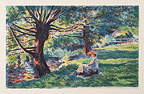
1.
Environs de Vernon, 1897
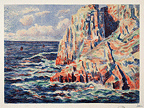
2.
Les Rochers rouge or La Mer à Camaret, 1897
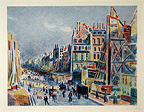
3.
Percement de la rue Réamur, 1897
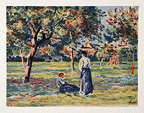
4.
Environs de Gisor, 1897
|
Maximilien Luce was born in 1858 to a working-class Parisian family. Despite his modest beginnings, Luce went on to become one of the founders of the Neo-Impressionist movement along with Camille Pissarro, Georges Seurat and Paul Signac. The Neo-Impressionists sought to improve upon the Impressionist style with a scientific method of painting called Pointillism.
Around 1900 however, Luce moved away from the pointillist technique of painting small dots of pure color, in favor of more expressive and spontaneous strokes. Not only did the artist distinguish himself from his colleagues with an instinctual, less rigid technique but also by his choice of subject matter. |

|
Please call (415) 433-2771 or inquire via e-mail for more information.